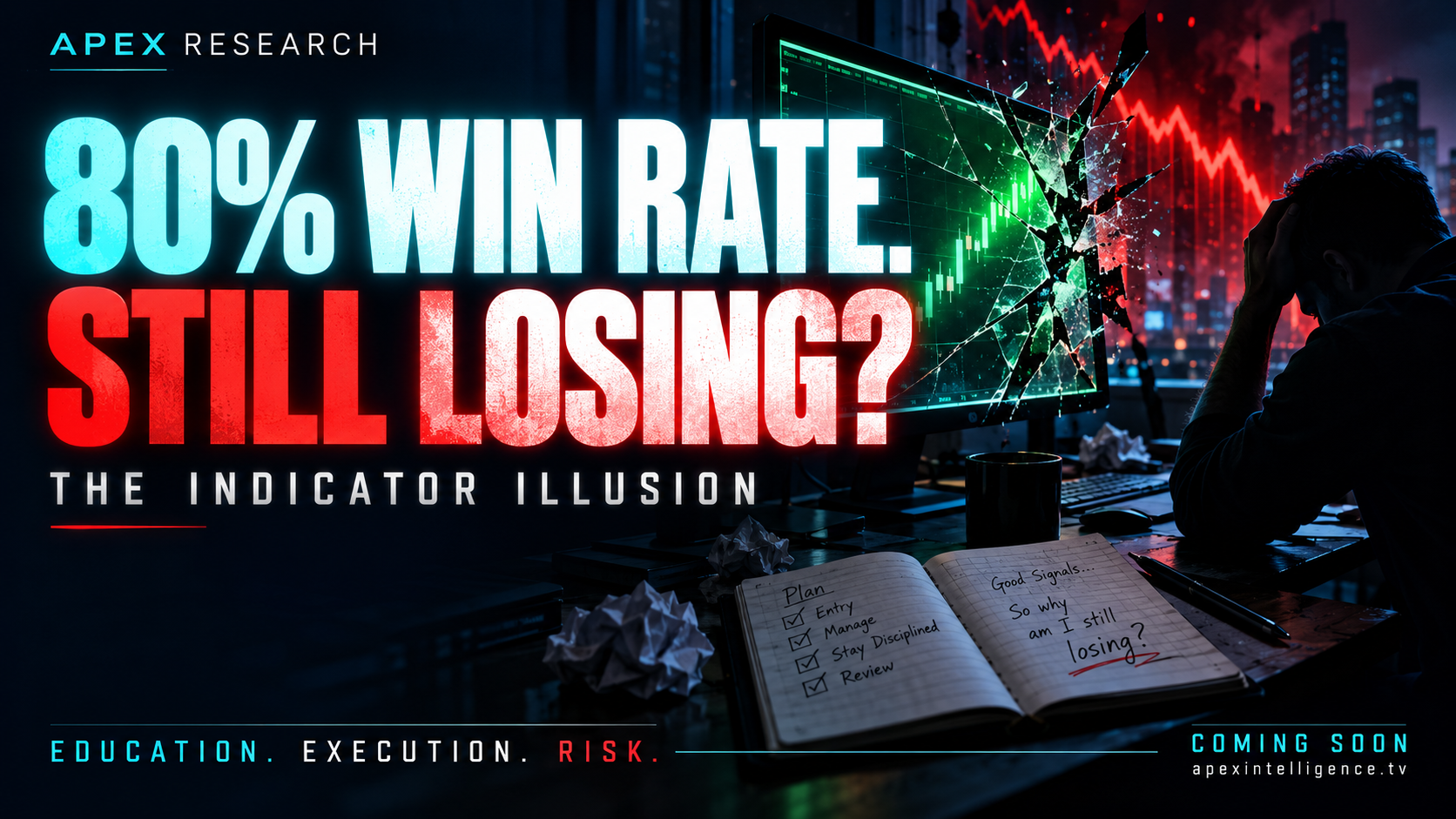
An arrow appears.A candle changes color. A dashboard announces confidence.
For someone struggling to become consistent, that display can offer something more attractive than information: relief. Finally, a clear answer. Finally, a way to stop second-guessing. Finally, a shortcut through the uncertainty.
But a signal cannot make a trading result understandable on its own. It cannot tell you whether the performance being advertised was achievable, whether the risk fits your account, or whether you understand the conditions under which the method fails.
Those questions still need answers. A purchase does not answer them.
The promise deserving scrutiny is that the right indicator will let you skip the difficult work of becoming a competent trader.
A Screenshot Can Show Wins And Hide A Losing System
Consider a hypothetical ten-trade record: eight wins of $100 and two losses of $500.
The win rate is 80%. The result is a $200 loss before commissions, spread, slippage or subscriptions. This is an arithmetic illustration, not an APEX performance result.
A close profit target can help produce frequent small wins. It does not guarantee them, and it does not automatically make a strategy bad. The problem appears when the losses, costs and exposure required to achieve those wins are left out of the sales pitch.
Win rate answers one question: how often did a trade finish profitably under the stated definition? It does not answer how much was won, how much was lost, or how much capital was endangered along the way.
A serious evaluation needs those answers together. It also needs a consistent definition of a trade: separate partial exits, scratch trades and repeated entries can change the headline percentage.
The CFTC specifically warns that hypothetical trading-system results can omit execution effects and costs, and that promoters may select favorable historical trades. Those omissions matter because customers must trade in actual markets and pay actual costs. [1]
When The Perfect Settings Know The Past
There is another way to manufacture confidence without establishing a durable advantage: keep changing the rules until the historical chart looks convincing.
Researchers David Bailey, Jonathan Borwein, Marcos López de Prado and Qiji Jim Zhu explain the problem of backtest overfitting: a configuration selected for excellent performance in the development sample can perform poorly outside it. Repeated selection among alternatives makes the development process itself part of the evidence that must be examined. [2]
That does not make optimization illegitimate. It means the winning version cannot be assessed honestly while the search that produced it remains invisible.
How many variations were tried? Which periods influenced the design? Was the supposedly unseen test repeatedly inspected and used to make changes? Were failed versions discarded without being reported?
If yesterday's test results become today's design instructions, that test is no longer untouched evidence.
Testing should be allowed to reject the idea. A process that keeps adjusting until it can declare victory is poorly equipped to discover failure.
The Arrow May Have Arrived Later
A chart can identify the exact candle at a historical turning point without having identified that turning point at the time.
For example, a pivot may only become identifiable after subsequent candles have formed. Drawing a marker back on the pivot candle can be useful for studying structure. Presenting that marker as if a trader received an actionable alert on the original candle tells a different story.
TradingView's documentation distinguishes normal updates on unfinished bars from potentially misleading historical plotting and future-information leakage. Not every form of repainting is deceptive or unusable. The important question is what information was available when a decision could actually have been made. [3]
Ask when the signal appeared, when it became confirmed, and what executable price followed. The marker's location alone cannot establish any of those facts.
Our Experience: The Tool Has Not Reproduced The Trader
This investigation also comes from a personal frustration within APEX. Our founder reports that the indicator implementations tested so far have not reproduced their discretionary trading process.
That is a useful starting point for research. It is not proof that discretionary trading always wins, that every indicator fails, or that the process could never be modeled.
Reproducing a trader requires identifying what the trader actually does. A written entry condition may omit decisions about market context, when to wait, how much exposure to take, how to manage a position and when to abandon an idea.
Before attributing results to any of those decisions, we need records that show them. A profitable account summary cannot tell us which decisions caused the profit. A losing trade cannot, by its size alone, establish that the trader ignored a stop or lost discipline.
The personal results supplied for this article are described as paper trading over roughly two weeks. They have not been independently audited here. We are therefore not presenting a claimed win rate, confidence interval or comparison with commercial indicators as proof of superior skill.
The question remains worthwhile: what knowledge and judgment does the trader contribute that the tested rules leave out?
Answering it requires documenting the process, not simply adding another indicator.
Hard Work Needs A Way To Correct Itself
Hours spent at a screen are not automatically hours spent learning.
Research by Brad Barber, Yi-Tsung Lee, Yu-Jane Liu and Terrance Odean examined day trading in Taiwan from 1992 to 2006. It found negative aggregate performance and many traders persisting despite substantial experience of losses. This was not an experiment comparing education programs with indicators; it does challenge the assumption that continued participation reliably produces competence. [4]
Useful work must be capable of changing our conclusions. Record the planned trade before the result is known. Separate adherence to the plan from whether the trade happened to win. Include costs. Examine repeated mistakes. Ask whether the method's assumptions still hold. Be willing to reduce exposure or stop when the evidence does not support continuing.
Education should improve a person's ability to ask and answer those questions. Watching more videos, memorizing terminology or paying for a course does not establish that improvement.
There is no honest promise that effort guarantees profitability. There is a clear difference between a process that measures its weaknesses and one that keeps purchasing reassurance.
The Same Scrutiny Belongs On Education Sellers
An exposé about shortcuts would be incomplete if it replaced indicator marketing with uncritical praise for trading courses.
In April 2022, the FTC announced a settlement with Warrior Trading over alleged deceptive earnings claims. It required $3 million in consumer redress and restrictions on unsubstantiated earnings representations. In January 2023, the agency announced more than $2.9 million in payments to affected consumers. [5]
This is a documented case concerning trading education and marketing. It is not evidence that all educators behave the same way, or a direct test of any indicator.
Its relevance is the standard of proof: a seller's results do not establish what a typical customer can expect. A testimonial does not supply the missing distribution of outcomes.
The same questions should follow the money whether the product is a script, a signal service, a mentorship or a course.
Indicators Still Have A Legitimate Role
Some technical tools can contain useful information. Andrew Lo, Harry Mamaysky and Jiang Wang found that several technical patterns provided incremental information in their historical U.S. stock sample. That finding is not equivalent to universal profitability after costs, but it is a reason to reject blanket claims that technical analysis has no value. [6]
A useful tool can organize observations, apply rules consistently or alert a trader to conditions worth investigating. A complete systematic strategy can also encode execution and risk controls; manual discretion is not automatically superior.
The standard is evidence for the particular method and its actual use. Neither a human decision nor an automated signal earns an exemption.
What Apex Should Be Willing To Show
APEX develops trading tools and has a commercial interest in this subject. Readers should apply the same scrutiny to us.
Any performance claim should identify the tested implementation, instrument, timeframe, dates, costs and execution assumptions. It should distinguish development results from genuinely unseen tests, and paper results from live trading. It should explain signal timing and disclose meaningful changes made after testing began.
It should also show losing periods and uncertainty. A result that depends heavily on a few large trades deserves examination, not automatic dismissal or automatic celebration.
No label—proprietary, institutional, AI-powered or otherwise—substitutes for that record. The CFTC has specifically warned about exaggerated AI trading-bot and signal claims. The technology's name does not verify its advertised performance. [7]
The work is understanding what you are using, testing what you believe, managing what you can lose and correcting what the evidence shows is wrong.
An indicator can help with that work. It cannot make the need for that work disappear.
Buy a tool for what it can demonstrate. Do not mistake the purchase for an education.
Not financial advice. Always trade with a plan and proper risk management.
Sources And Credits
Original editorial synthesis: APEX Research. Personal perspective: founder's account supplied October 5, 2026. Cover: AI-generated conceptual illustration; not a market chart or performance record. Sources checked October 5, 2026. No proprietary indicator code, private strategy rules or independently verified comparative backtest is disclosed or claimed in this article.
[1] CFTC, Commodity Trading Systems Sold on the Internet. Customer advisory on hypothetical performance, costs and verification.
Source 1
[2] David H. Bailey, Jonathan M. Borwein, Marcos López de Prado and Qiji Jim Zhu, The Probability of Backtest Overfitting. Author-hosted revised manuscript, February 27, 2015.
Source 1
[3] TradingView, Pine Script documentation: Repainting.
Source 1
[4] Brad M. Barber, Yi-Tsung Lee, Yu-Jane Liu and Terrance Odean, Do Day Traders Rationally Learn about Their Ability? Author-hosted working paper; Taiwan, 1992–2006. The paper later appeared under the title Learning, Fast or Slow. The claim here refers to the retrieved working paper.
Source 1
[5] FTC, Federal Trade Commission Cracks Down on Warrior Trading For Misleading Consumers With False Investment Promises, April 2022; FTC Returns More Than $2.9 Million To Consumers Harmed by Warrior Trading, January 2023. Allegations and settlement described as such; no broader misconduct inference made.
Source 1 Source 2
[6] Andrew W. Lo, Harry Mamaysky and Jiang Wang, Foundations of Technical Analysis: Computational Algorithms, Statistical Inference, and Empirical Implementation. NBER Working Paper 7613, March 2000; published in The Journal of Finance. NBER abstract retrieved; full NBER page fetch was unavailable during this review.
Source 1 Source 2
[7] CFTC, Customer Advisory Cautions the Public to Beware of Artificial Intelligence Scams, January 25, 2024.
Source 1